

Expertise is the most important part of any technical solopreneurship story: whether you’re consulting, building products, or teaching others, your expertise is probably why you started it in the first place.
There are many ways to build expertise - working as an employee on challenging projects, running experiments, learning from others. Each lesson makes you a bit smarter.
But can you recall every single lesson over the last few years? Some people have fantastic memory, but I bet you've had situations where you struggled to answer a very specific question. You definitely knew it at one point, but couldn’t remember it later.
A few years ago, I started seeing “second brain” examples quite regularly. If I were to oversimplify, a second brain is essentially a personal knowledgebase - a place where you keep all your notes. How is it different from note-taking apps? And why is it so important for a technical solopreneur?
How It’s Different From Note-Taking
A second brain is much more than just a collection of text files. A great second brain:
Has a lot of structure and organization: categories, tags, labels, linked posts, different views.
Is searchable, not just with keywords, but semantically.
Leverages graphs, which makes it possible to see connections.
Curated. It’s not a dumping ground.
You don’t need to create all the content. You can save posts, videos, podcasts, papers, slides, etc. that you find valuable. If you do this for a while, you can build a huge collection of resources that’s relevant, linked, and easily searchable.
Here’s a quick example from my second brain:
I attend a conference.
Before the conference, I create a document listing the talks I want to attend. It’s tagged and contains properties like Date and Event.
While at the conference, I write notes about those talks + anything else (e.g. an interesting conversation I had). I tag it similarly and link it to the same Event.
After the conference, I use the notes to draft a post about a conference, e.g. something like this. Same tags and the Event property.
I add any talks I haven’t attended as individual talks I’d like to watch. I have a special “consumed” property with a view of “unconsumed” resources, essentially my TODO watch/read list. Again, same Event value and tagging.
In the end, I have a bunch of notes, a public post, several TODO talks, all perfectly linked with tags and the same Event property.
Ownership and How to Start
Don’t have anything right now? You could start by simply registering a Notion account. It has great UX, decent search, and a free plan is available.
However, your data will be owned by Notion. Yes, it has export functionality, but I found it clunky and incomplete. However, that’s exactly how I started with my second brain a few years ago.
Earlier this year, I migrated all my notes, bookmarked resources, and RSS feeds to a purpose-built system that I fully own. All data is stored on S3 with rclone for bi-directional sync. I use Obsidian as a client, but I can switch any time - pretty much everything is just a Markdown file with some metadata.
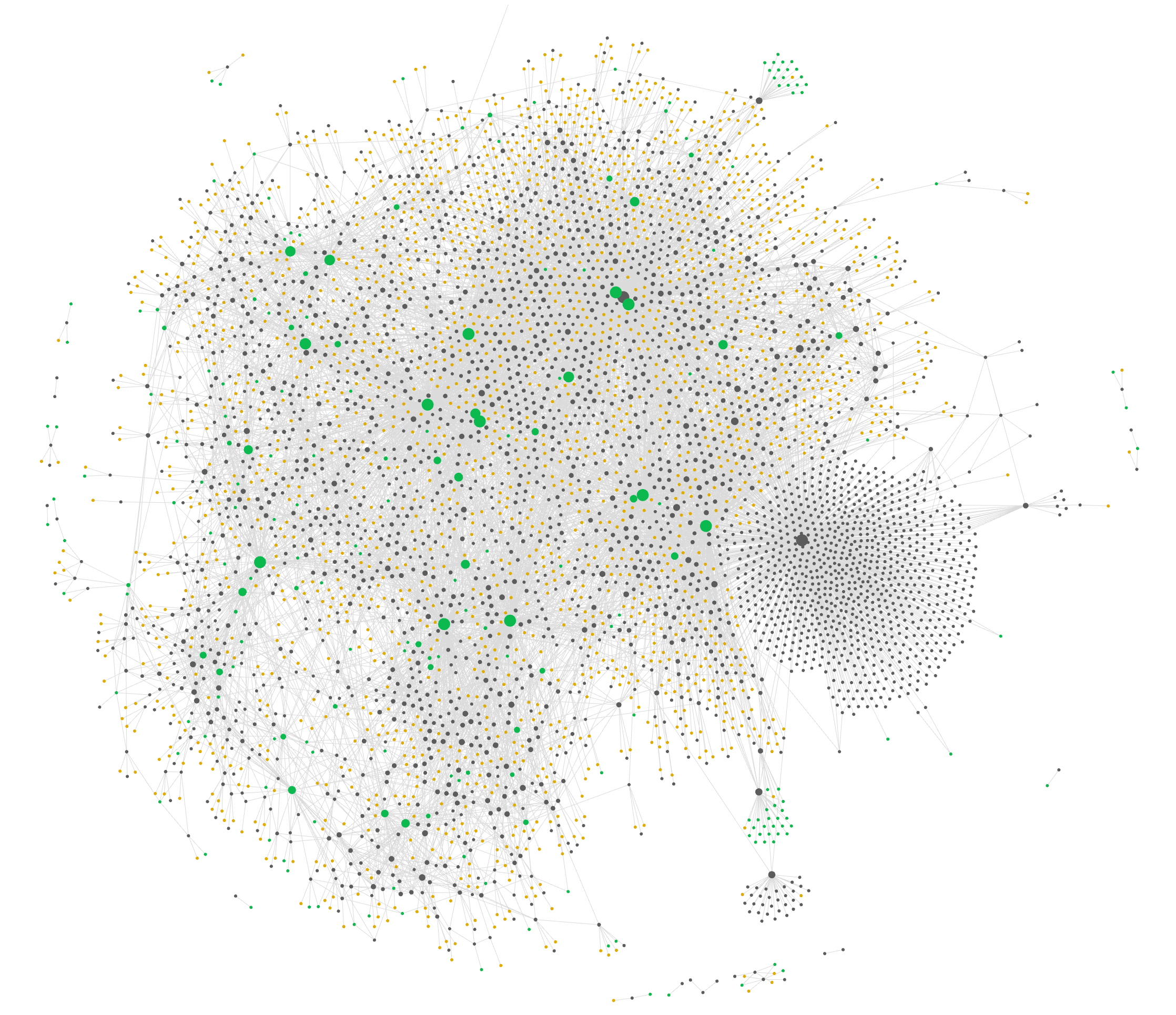
I currently have 5044 files in 156 folders in my Obsidian vault. Here’s the graph view if you’re curious:
I also started building tools (see the next section) because S3 is an easy target for reads and writes.
If you’re still confused, I recommend starting here.
LLMs Made It Much More Powerful
LLMs let you build any tool you can think of quickly and cheaply.
For example, you can build a toolkit that helps you with populating your second brain.
Let’s say you’re interested in an open-source technology and it has a mailing list maintained by the community members. You can build a tool that regularly (daily? weekly?) reads all emails, extracts insights and summarizes them for you. The summary becomes automatically available in your second brain.
Another example: whenever I’d like to save a YouTube video to my second brain, a Claude skill is triggered that downloads the video (using yt-dlp) and the captions (if available; if not, it uses whisper-cli for transcription), then a note with a talk summary and key insights is generated.
You can apply a similar approach to RSS feeds, social media, etc. In fact, I think it’s becoming more and more important to save the online resources instead of simply bookmarking them. For a while, I used different bookmarking services (first Pocket, then Raindrop). However, when I recently needed to move ~1000 bookmarked resources to my second brain, about ~10% were no longer available.
On the read side, make your second brain available as a set of MCP endpoints and enable them in your favourite harness. This doesn’t just make the agents smarter; it makes them smarter in a specific way.
Using It
A second brain is an absolute must-have for any technical solopreneur. You can use it to:
Quickly answer very specific customer questions. Always have backing resources - “here’s why you should do this”.
Perform research. Combine with LLMs: they are quite good at processing and searching Markdown files.
Gather ideas for new posts. See unlikely connections.
Build new educational products. You may have enough material for a course or a book.
Even build content factories - see Eden.